Tuesday, May 24, 2016

E-cigarettes and E-hookahs

Electronic cigarettes (e-cigarettes) and electronic hookahs (e-hookahs) allow the user to inhale a vapor that may contain nicotine as well as other flavors and chemicals. Many e-cigarettes and hookahs look just like real cigarettes or pipes. But some look like pens or USB memory sticks. Not much is known yet about the benefits and risks of these products.

How they work
There are many types of e-cigarettes and e-hookahs. Most have a battery-operated heating device. When you inhale, the heater turns on and heats a liquid cartridge into a vapor. The cartridge may contain nicotine or other flavors or chemicals. It also contains glycerol or propylene glycol (PEG), which looks like smoke when you exhale. Each cartridge can be used a few times. Cartridges come in many flavors.

Uses
The makers of e-cigarettes and e-hookahs market their products for several uses:

To use as a safer alternative to tobacco products. The makers claim their products don't contain the harmful chemicals found in regular cigarettes. They say this makes their products safer choices for those who already smoke and don't want to quit.
To "smoke" without getting addicted. Consumers can choose cartridges that don't contain nicotine, the addictive substance found in tobacco.
To "smoke" in areas where smoking is banned. Since there are not yet bans against e-cigarettes in many places, these products allow smokers to "smoke" in smoke-free areas.
To use as a tool to help you quit smoking. Some companies tout their products as a way to quit smoking. More studies are needed to prove this claim.
E-cigarettes have not been fully tested. So it is not yet known if any of these claims are true.

Safety concerns
Health experts have many concerns about the safety of e-cigarettes and e-hookahs.

There is no evidence that shows these products are safe to use over the long term.
There are chemicals that can cause cancer in some of the products they tested. One sample contained a toxic ingredient found in antifreeze.
The ingredients in e-cigarettes are not labeled, so it's not clear what's in them.
It's not known how much nicotine is in each cartridge. The FDA found nicotine in one sample that was labeled nicotine-free.
It is not known if these devices are a safe or effective way to quit smoking.
Non-smokers may start using e-cigarettes because they believe these devices are safe.
E-cigarettes and children
Many experts also have concerns about the effects of these products on children.

These products are sold in flavors that may appeal to children and teens, such as chocolate and key lime pie. This could lead to more nicotine addiction in children.
Teens who use e-cigarettes may be more likely to take up smoking regular cigarettes.
More studies are needed
There is not enough information about e-cigarettes to know if they are safe or harmful. Until more is known about their long-term effects, the FDA and the American Cancer Association recommend steering clear of these devices.

If you are trying to quit smoking, your best bet is to use FDA-approved smoking cessation aids. These include:

Nicotine gum
Lozenges
Skin patches
Nasal spray and oral inhaled products
When to call the doctor
If you need more help quitting, talk with your health care provider.

Alternative Names
Electronic cigarettes; Electronic hookahs; Vaping

Electronic cigarette aerosol and e-liquid

Aerosol (vapor) exhaled by an e-cigarette user.

The aerosol of electronic cigarettes is generated when the e-liquid reaches a temperature of roughly 100–250 °C within a chamber. The user inhales the aerosol, commonly called vapor, rather than cigarette smoke.The aerosol provides a flavor and feel similar to tobacco smoking. In physics, a vapor is a substance in the gas phase whereas an aerosol is a suspension of tiny particles of liquid, solid or both within a gas. The aerosol is made-up of liquid sub-micron particles of condensed vapor  which mostly consist of propylene glycol, glycerol, water, flavorings, nicotine, and other chemicals. The various chemicals in the aerosol give rise to many issues concerning the safety of electronic cigarettes that have been much discussed. After a puff, inhalation of the aerosol travels from the device into the mouth and lungs. A 2014 review found that the particles emitted by e-cigarettes are comparable in size and number to particles in cigarette smoke, with the majority of them in the ultrafine range. The particles are of the ultrafine size which can go deep in the lungs and then into the systemic circulation. A 2014 review said local pulmonary toxicity may occur because metal nanoparticles can deposit in the lungs. Others show that the quantities of metals emitted are minimal and permissible by medicinal standards.

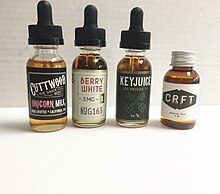
Various bottles of e-liquid.
After the aerosol is inhaled, it is exhaled. Emissions from electronic cigarettes are not comparable to environmental pollution or cigarette smoke as their nature and chemical composition are completely different. The particles are larger, with the mean size being 600 nm in inhaled aerosol and 300 nm in exhaled vapor. Bystanders are exposed to these particles from exhaled e-cigarette vapor. There is a concern that some of the mainstream vapor exhaled by e-cigarette users can be inhaled by bystanders, particularly indoors, and have significant adverse effects. Since e-cigarettes involve an aerosolization process, it is suggested that no meaningful amounts of carbon monoxide are emitted. Thus, cardiocirculatory effects caused by carbon monoxide are not likely. E-cigarette use by a parent might lead to inadvertent health risks to offspring. E-cigarettes pose many safety concerns to children.For example, indoor surfaces can accumulate nicotine where e-cigarettes were used, which may be inhaled by children, particularly youngsters, long after they were used.
E-liquid is the mixture used in vapor products such as electronic cigarettes. The main ingredients in the e-liquid usually are propylene glycol, glycerin, nicotine, and flavorings. However, there are e-liquids sold without propylene glycol, nicotine, or flavors.The liquid typically contains 95% propylene glycol and glycerin.The flavorings may be natural or artificial. About 8,000 flavors exist as of 2014. There are many e-liquids manufacturers in the USA and worldwide.] While there are currently no US Food and Drug Administration (FDA) manufacturing standards for e-liquid, the FDA has proposed regulations that are expected to be finalized in late 2015. Industry standards have been created and published by the American E-liquid Manufacturing Standards Association (AEMSA).

Composition

Aerosol

The vapor usually contains nicotine, glycerin, propylene glycol, flavors and aroma transporters. The nicotine levels in the vapor varies either from puff-to-puff or among products of the same company A 2015 report commissioned by Public Health England concluded that e-cigarettes "release negligible levels of nicotine into ambient air". E-cigarettes without nicotine are also available. The vapor may also contain tiny amounts of toxicants, carcinogens, and heavy metals.Contamination with various chemicals has been identified.E-cigarette makers do not fully disclose information on the chemicals that can be released or synthesized during use. The metals have been found in trace amounts in the vapor, some of them at higher amounts than in cigarette smoke. The peak concentration of nicotine delivered by e-cigarette use is comparable to that produced by conventional cigarette smoking.

E-liquid


E-liquid, e-fluid, or e-juice is the mixture used in vapor products including e-cigarettes. E-Liquids come in many variations, including different nicotine strengths and many different flavors. The main ingredients are propylene glycol, glycerin, and flavorings; and most often, nicotine in liquid form. The liquid typically contains 95% propylene glycol and glycerin, and the remaining 5% being flavorings and nicotine. E-liquid can be made with or without nicotine, with >90% of e-liquids containing some level of nicotine. The most regularly used base carrier chemical is propylene glycol with or without glycerinE-liquid containing glycerin and water made without propylene glycol are also sold.It is uncertain whether the nicotine used in e-liquid is manufactured using a United States Pharmacopeia (USP) grade nicotine, a tobacco plant extract, tobacco dust or a synthetic nicotine. Most e-cigarette liquids contain nicotine, but the level of nicotine varies depending on user-preference and manufacturers. Although some e-juice is nicotine-free, surveys demonstrate that 97% of responders use products that contain nicotine. A 2015 review suggests that 1% of users use liquid without nicotine.
V2 Cigs electronic cigarettes - Taste. Trust. Technology.